Ford Cortina MKIV
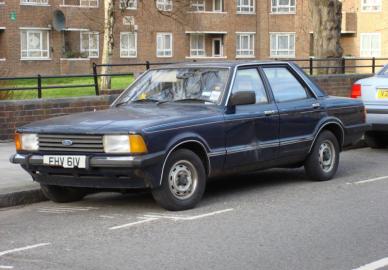
Specification
- Production 1976-1979
1,131,850 units (including Mark 5) 1977-1980<aus - Designer(s) Uwe Bahnsen
- Body style(s) 2-door saloon
4-door saloon
5-door estate
2-door convertible (conversion)
2-door pickup (P100) - Engine(s) 1.3L OHV "Kent" Straight-4
1.6L OHC "Pinto" Straight-4
2.0L OHC "Pinto" Straight-4
2.3L OHV "Cologne" V6
3.0L OHV "Essex" V6 (South Africa)
3.3L OHV Straight-6 (Australia)
4.1L OHV Straight-6 (Australia)auto bourg warner 35 gearbox on straight 6 and alloy head after late 1979 on some 4.1 straight 6 te aus points less distributor (elec control module)on some later models te straight 6
The history of the Ford Cortina MKIV
The fourth-generation Cortina was a more conventional design than its predecessor, but this was largely appreciated by fleet buyers. Generally a re-body of the Mark III, as an integration of Ford's model range, this car was really a re-badged Ford Taunus. Many parts were carried over, most notably the running gear, and even the dashboard design.
This series spawned the first Ghia top-of-the-range model, which replaced the 2000E. The 2.3 L Ford Cologne V6 engine was introduced in 1977 as an engine above the 2.0 L Pinto engine, already a staple of the Capri and Granada ranges. The 2.0 L Ford Cologne V6 engine continued to be offered on Taunus badged cars in parallel with the Pinto unit, and offers here an interesting comparison with the similarly sized in-line four-cylinder Pinto engine. The V6 with a lower compression ratio offered less power and less performance, needing over an extra second to reach 50 mph (80 km/h). It did, however, consume 12˝% less fuel and was considered by motor journalists to be a far quieter and smoother unit. The 2.3 L was available to the GL, S and Ghia variants. A 1.6 Ghia option was also introduced at the same time as the 2.3V6 models in response to private and fleet buyers who wanted Ghia refinements with the improved fuel economy of the smaller 1.6 Pinto engine. Two-door and 4-door saloons and a five-door estate were offered with all other engines being carried over. There was a choice of base, L, GL, S (for Sport) and Ghia trims, again not universal to all engines and body styles. The dashboard was carried over intact from the last of the Mark III Cortinas while the estate used the rear body pressings of the previous 1970 release Taunus.
Throughout its production life, the Mark IV was the most popular new car in the United Kingdom. Despite this, it is now the rarest of all Cortinas. Scant rustproofing (much improved on the later "Cortina 80" models) and popularity with banger racers accelerated its demise. The S models are now particularly rare, with less than a dozen 2.0S and apparently just 1 of the 2.3S models respectively said to survive today. 2.3 Ghia Mark 4 models are also rare, with less than 20 of them believed to have survived. The S models were discontinued when Mark 4 production ended. In their place, an optional 'S' pack was available for most Mark 5 models. Again, Ford Australia built its own versions with the 2.0-litre 4-cylinder Pinto unit and the Ford Falcon's 3.3 and 4.1L 6-cylinder unit. Interior door hardware and steering columns were shared with the Falcons and the Aussie versions also had their own instrument clusters, optional air conditioning and much larger bumpers. A considerable number were exported to New Zealand under a free trade agreement where they were sold alongside locally-assembled models similar to those available in the UK.
Ford for sale
- Ford Cortina MkIII
-
1972 Cambridgeshire
 GBP9,995Trade sale Views: 6559
 - Ford Cortina Lotus MK II
-
1968 London
 GBP4,880Private sale Views: 5975
 - Ford Cortina MK II
-
1970 Bristol
 GBP6,995Trade sale Views: 18732
 - Ford Cortina MK II
-
1968 London
 GBP3,800Private sale Views: 5703
 - Ford Cortina MK II
-
1968 County Meath
 GBP11,000Private sale Views: 28068
 - Ford Cortina MK II
-
1968 London
 GBP5,200Private sale Views: 5861